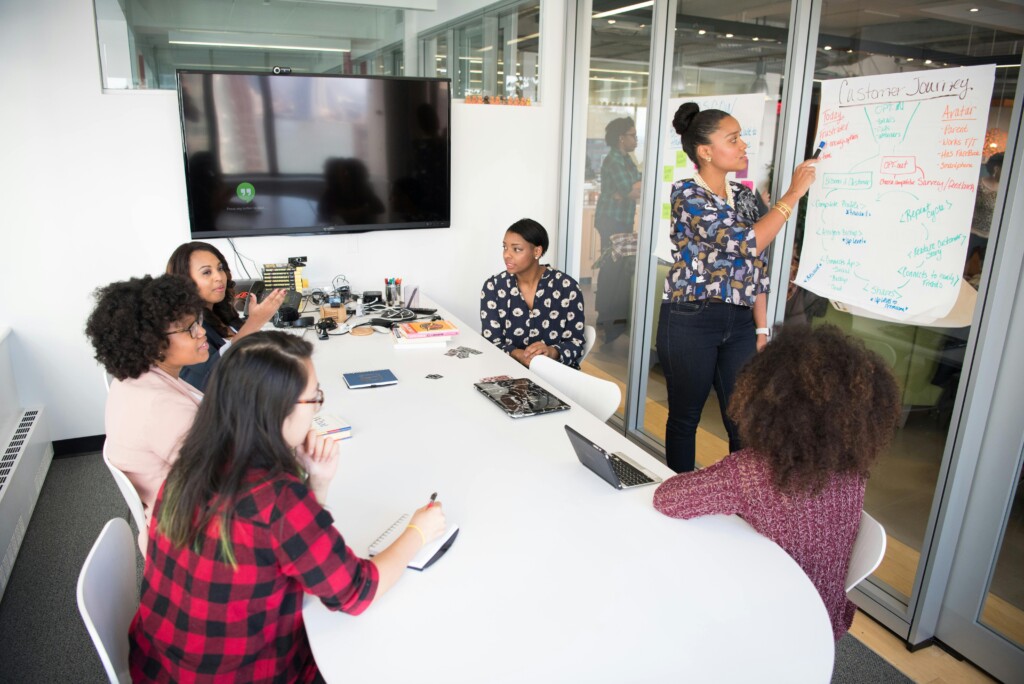
When women innovate, they include, they structure, and they transform. This fundamental truth should guide our collective approach to technological development. It’s precisely this ability to think differently, to place humanity at the heart of performance, that makes women essential players in tomorrow’s innovation.
The State of Tech in Quebec and the Place of Women
The Quebec artificial intelligence market is expected to reach new heights in the coming years, with an annual growth rate exceeding 14% (Grand View Research, 2024). Cybersecurity is emerging as a strategic sector where Quebec can shine thanks to its recognized AI expertise. Nearly 13% of Quebec businesses have already integrated artificial intelligence applications into their operations (Statistics Canada, 2023), and this figure continues to climb.
In this expansion context, where do women stand? The statistics remain concerning. In Quebec, women represent only 23% of professionals working in science and technology fields (Engineers Canada, 2023). In engineering, the proportion barely reaches 15%, with an ambitious goal of 30% by 2030 (Government of Quebec). In computer science programs, they constitute only 19% of enrollments at the college level (Quebec Ministry of Higher Education).
Even more troubling: in leadership positions within technology sectors, women in tech remain largely in the minority. Only 3% of software founders studied in Canada are women (Startup Genome, 2023). In the French Tech 120, a showcase of the most promising technology companies, there are barely 12.5% women co-founders or CEOs (La French Tech, 2024).
Yet Quebec possesses a unique advantage that could turn the tide: its collaborative culture. Our entrepreneurial ecosystem values partnerships, knowledge sharing, and mutual support. These values create fertile ground for greater diversity, provided we collectively seize the opportunity.
Why Female Contribution is Essential to Innovation
Women in tech don’t just bring skills equal to those of men. They bring a different vision of innovation, and it’s precisely this difference that enriches and strengthens our companies.
Human-centered orientation constitutes the first pillar of this distinctive approach. Where some see technology for technology’s sake first, women leaders tend to systematically ask the question of human impact. How will this innovation concretely improve users’ lives? Who might be excluded or disadvantaged? This sensitivity to user experience and inclusion isn’t a “plus”—it’s a necessity in a world where technology must serve all of society.
Sense of impact also guides their approach. Women entrepreneurs in tech often demonstrate a remarkable ability to align economic performance with social responsibility. They don’t just create viable products: they create sustainable solutions that meet real needs while considering ethical and environmental issues.
Collaborative intelligence may represent the most powerful asset. In a sector often marked by fierce competition and individualism, women leaders favor co-creation, knowledge sharing, and building strong networks. This approach proves particularly effective in complex technological projects that require orchestrating multiple areas of expertise.
Finally, studies confirm it: women in tech generally adopt more sustainable management less focused on extreme risk. This calculated prudence, far from being a brake, constitutes a factor of stability and sustainability for technology companies. At a time when so many startups exhaust themselves in a frantic race for growth at all costs, this balanced vision becomes a true competitive advantage.
In a hypertech world where automation and artificial intelligence are transforming how we work, relational skills paradoxically become more strategic than ever. Knowing how to unite teams, inspire confidence, create meaning: these are strengths that women leaders master brilliantly.
The Key Role of Women’s Networks in Tech
Entrepreneurship isn’t built in isolation. The numbers are eloquent: 82% of professional women active in the workforce believe that the opportunity to interact with women leaders and create networks will help advance their careers (KPMG, 2023). And for good reason: 67% of women say they learned their most important leadership lessons from other women (McKinsey & Company, 2023).
Quebec is full of initiatives that foster these essential connections. The Réseau des Femmes d’affaires du Québec (RFAQ), with its 45 years of existence, continues to inspire, connect, and propel thousands of women. Its RFAQ+ platform connects women entrepreneurs with national and international decision-makers, opening doors to new markets.
The Quebec Technology Association (AQT) has developed a specific “Women in Tech” program to eliminate systemic barriers and promote women’s access to strategic positions. Funds like Accelia Capital, launched by Christine Beaubien and Annick Charbonneau with support from the Quebec government, specifically aim to finance women-owned companies in the technology sector.
Networking thus becomes much more than a simple social activity: it’s a concrete growth engine. Women in tech who access strategic networks see their business opportunities multiply, their skills sharpen, and their confidence strengthen. They find mentors, partners, investors, and clients. They also create role models for the next generation.
Because seeing women succeed in tech is not anecdotal. According to a KPMG study, 86% of women say that seeing an increased number of women in leadership positions leads them to believe they can access these positions themselves (KPMG, 2023). The power of example is immense.
What Needs to Change to Further Propel Women in Tech?
If we truly want to transform the Quebec technology ecosystem, five action levers are essential.
Access to funding remains the most glaring obstacle. A study reveals that in 2021, all-female teams raised 3.4 times less funding than male teams, and no funding round exceeding $50 million was completed by an exclusively female team (Observatory of Women’s Entrepreneurship, 2022). This structural inequality demands targeted solutions: funds dedicated to women entrepreneurs, flexible financing programs adapted to the realities of “flexipreneurs” (these part-time entrepreneurs who represent a growing share of the ecosystem), and investor awareness of unconscious biases.
Specialized mentorship constitutes the second essential pillar. Programs like Réseau M, in partnership with Femmessor, or Women’s Equity Lab initiatives that train women investors, create essential bridges. Mentorship doesn’t just transmit technical knowledge: it opens doors, breaks isolation, and builds the confidence necessary to dare.
Inclusive recruitment must become the norm, not the exception. Quebec tech companies must revise their hiring practices, selection criteria, and organizational cultures to attract and retain female talent. This involves inclusive job descriptions, diverse interview panels, and work-life balance policies that are actually applied.
Accessible technology programs constitute a fourth lever. We must act as early as high school and CEGEP to break stereotypes that keep girls away from STEM careers. Initiatives like HEC Montreal’s Fondatrices program or École des entrepreneurs du Québec’s FAIR·E demonstrate that with the right support, women in tech excel in these fields.
Finally, networking platforms between large companies and women tech entrepreneurs must multiply. The Maïa platform, which connects Canadian women entrepreneurs and large companies, illustrates the potential of these collaborative ecosystems. These bridges create not only business opportunities but also tangible recognition of the added value of women in tech.
Vision: An Innovative Quebec Where Women Code, Lead, Invest, and Influence
Imagine Quebec in 2030. A Quebec where the boardrooms of tech companies reflect the diversity of our society. Where young girls naturally see programming and technology entrepreneurship as avenues open to them. Where investors recognize that diversifying their portfolios also means investing in mixed teams with complementary visions.
This Quebec is not a utopia. It’s within our reach, provided we collectively accept a fundamental truth: we can no longer afford tech without women.
Every woman who launches her startup, every leader who breaks a glass ceiling, every investor who finances an innovation, every programmer who solves a complex problem: all are paving the way. They prove that excellence and inclusion don’t oppose each other. On the contrary, they mutually reinforce each other.
Quebec innovation will be female or it won’t live up to its potential. Because in a rapidly transforming world, we need all intelligences, all perspectives, and all forms of boldness. Women in tech aren’t asking for a seat at the table out of charity. They’re claiming it because they have the skills, vision, and determination to transform this sector.
The time has come to act. For companies, investors, educational institutions, and governments: the message is clear. Investing in women in tech means investing in Quebec’s future. It’s choosing inclusive innovation over sterile exclusion. It’s building a 21st-century economy that truly reflects who we are.
Women transforming Quebec tech are no longer an exception to celebrate. They’re becoming the norm to encourage. And it’s together—women and men, entrepreneurs and investors, pioneers and the new generation—that we’ll write this next chapter of our technological history.