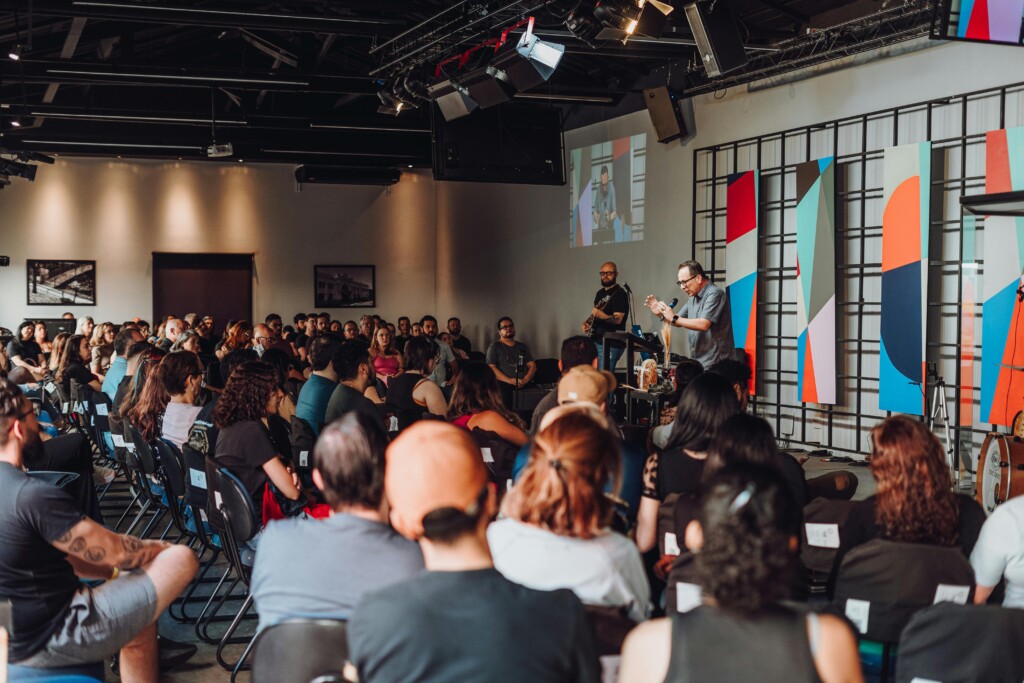
According to the Global Meetings Industry Forecast 2025 by American Express GBT, 82% of organisers believe 2026 will mark a new phase of maturity: events must now combine technological performance, environmental responsibility, and authentic emotion.
Here are the key trends to watch for industry players, from specialised agencies to companies seeking measurable impact.
AI Becomes a Strategic Ally, Not a Simple Gadget
Artificial intelligence has definitively moved beyond the experimental stage to establish itself as an essential tool for event planning, personalisation, and optimisation.
Automation of Low-Value Tasks
In 2026, the majority of event platforms will integrate AI assistants capable of automatically generating personalised communications, intelligently managing complex registrations, or suggesting custom programmes adapted to participant profiles.
This automation frees human teams to focus on what truly matters: strategic creativity, conceptual innovation, and excellence in client experience.
Intelligent Matchmaking and Truly Augmented Networking
AI-based recommendation systems, already successfully used by platforms like B2B/2GO, will become even more sophisticated in 2026. They’ll integrate advanced behavioural criteria, detected commercial intent, and measured professional affinity.
Business meetings will be not only more relevant and targeted, but also measurable in terms of concrete commercial impact and participant satisfaction.
Predictive Analysis and Real-Time Optimisation
Organisers will be able to accurately anticipate actual participation rates, identify attention peaks during sessions, and measure engagement levels minute by minute, adjusting content and pace on the fly.
According to EventMB (2025), 61% of industry professionals state that AI will significantly improve the quality of strategic decisions made during events themselves.
Sustainability as a Non-Negotiable Requirement
The ecological transition now establishes itself as an unavoidable standard in the business world, and the event industry must imperatively align or risk losing credibility.
Carbon-Neutral Events and Environmental Certification
Conscious companies tend to prioritarily choose certified sustainable venues (BOMA BEST, LEED, Green Key) and systematically offset emissions related to participant transportation.
Canada particularly distinguishes itself through its voluntary commitment: Destination Canada already supports over 200 reduced-environmental-impact events annually, with ambitious growth targets.
Local Suppliers and Prioritised Short Supply Chains
Local service providers are rapidly gaining popularity, drastically reducing transportation costs and directly supporting regional economies. Menus composed of local, seasonal ingredients, along with systematic reduction of food waste, become tangible symbols of concrete commitment.
Mandatory Transparency and Environmental Reporting
Organisers must now prove their ecological efforts through quantified and verifiable sustainability reports, openly shared with participants, sponsors, and the public. This transparency becomes a selection criterion for many corporate participants.
The Powerful Return of Emotion and Humanity
After years of massively digitalised and often impersonal events, the need for authenticity, genuine connection, and memorable experiences has returned to the forefront of expectations.
Immersive Multisensory Experiences
Thoughtful scenography, carefully curated ambient music, and creative gastronomy integrate into a truly holistic approach to participant experience. Events strategically leverage coordinated stimulation of all five senses to foster lasting memorisation and emotional engagement.
Deliberately More Intimate Formats
Large anonymous conferences progressively give way to human-scale encounters: targeted business retreats, thematic reflection circles, round tables limited to 15-20 participants.
According to Skift Meetings (2025), 68% of business participants now prefer shorter, genuinely interactive, and deeply immersive formats rather than traditional large passive gatherings.
Inclusion and Well-Being Placed at the Centre
Structured wellness breaks, dedicated quiet zones for disconnection, authentic diversity of speakers, and universal accessibility become expected standards, not optional extras.
Events that authentically integrate these dimensions see their participant satisfaction rate climb by 30%, according to PCMA (2025).
Hybridisation Intelligently Reinvents Itself
The hybrid model, popularised during the pandemic, enters a new era of maturity: that of technological coherence and experience equity.
Much More Integrated Platforms
Video broadcasting tools, intelligent networking, and behavioural analysis converge towards unique, intuitive interfaces where user experience becomes truly fluid and fully measurable.
Physical and virtual participants now access the same premium content and benefit from the same qualified meeting opportunities, eliminating the frustration of being a “second-class participant” virtually.
The Confirmed Rise of “Phygital” Events
Phygital events, harmoniously combining physical and digital reality, offer natural experience continuity before, during, and after the official event.
Interactions can begin online via dedicated platforms, continue intensely in person during the event, then extend durably via actively animated virtual communities.
Fine Adaptation to Time Zones and Languages
Internationally-focused events intelligently rethink their session schedules, content formats, and communication languages to respectfully adapt to diverse global audiences.
Advanced platforms now translate discussions and presentations in real time, effectively breaking down cultural and geographical barriers that previously limited reach.
Data Analysis Becomes the New Measure of Success
Events in 2026 will be driven by behavioural and transactional data. Each digital interaction, click of interest, or attended session will enable fine understanding of participant behaviour and evaluation of actual investment profitability.
Detailed Participant Journey Tracking
Through intelligent data centralisation, it becomes possible to precisely identify sessions generating the most engagement, themes most sought by audience segments, and critical moments of disengagement or fatigue.
Precise Relational ROI Measurement
Modern platforms now enable objective measurement of established business connection rates, volume of post-event follow-ups conducted, and even the number of concrete commercial collaborations directly resulting from the event.
This analytical approach transforms networking into a genuine strategic performance indicator, finally moving beyond the anecdotal.
Democratisation of Advanced Analytical Tools
Simplified visual dashboards, accessible in real time on mobile, will enable marketing teams and management to track key results without particular technical expertise.
According to Bizzabo (2025), events that systematically leverage data continuously record measurable ROI 47% higher than those sticking to traditional basic metrics.
Conclusion: Towards Responsible Maturity
The 2026 event industry resolutely moves towards an era of responsible maturity: more authentically human, more intelligently technological, and more rigorously measurable.
Technologies become powerful levers for enriched experience, not simple cosmetic artifices. Data transforms into continuous improvement tools, not vanity numbers. And sustainability becomes an unavoidable condition of credibility, not a simple marketing argument.
Players who skilfully combine technological innovation, strategic relevance, and relational authenticity will succeed in an increasingly demanding market.
For ambitious companies, relying on experienced technological partners like B2B/2GO, capable of harmoniously uniting event strategy, cutting-edge technology, and intelligent networking, will become a truly decisive competitive advantage.
📚 Sources and References
- American Express GBT, Global Meetings Industry Forecast, 2025
- EventMB, Event Technology and AI Impact Report, 2025
- Destination Canada, Sustainable Events Initiative, 2025
- Skift Meetings, Global Event Trends, 2025
- PCMA, Business Events Insights, 2025
- Bizzabo, Event Trends Report, 2025